Resources
- Details
- Parent Category: Content
- Category: Resources
CVPDC works to connect member local governments to resources outside of our region. The following opportunities are currently available from federal, state, and other partners. Interested parties are encouraged to contact staff to learn more.
Love Your Block 2026-2028
Applications are due June 1, 2026.
Love Your Block is a two year civic engagement program that brings city leaders and residents together to strengthen neighborhoods, one block at a time. Selected cities will receive $270,000, coaching, and implementation support to turn community priorities into action. From transforming vacant lots into community gardens to removing trash and debris from a public right-of-way, the program supports cities in engaging with their residents to design, develop, and deliver small-scale neighborhood improvement projects that make their communities and cities better places to live.
Crossing Safety Program / Railroad Crossing Elimination (RCE) Grant Program
Applications are due June 8, 2026.
The Federal Railroad Administration (FRA) has announced a $1.1 billion investment to improve safety infrastructure at railroad crossings. Funds are available for projects that: build overpasses or underpasses so cars and trains never meet, upgrade safety technology at crossings, relocate tracks to close a grade crossing, and educate Americans on how to cross train tracks safely.
FY27 Community Business Launch
Applications are due June 17, 2026.
The Community Business Launch (CBL) is a place-based entrepreneurial development strategy that fills a critical mass of vacant storefronts with expansion or start-up ventures. Local CBL programs train entrepreneurs, creatives, and small business owners about business planning practices. This training culminates in a group of finalists pitching their ideas to a panel of judges, with winners receiving grant funding and support services from the community to kick-start their new venture.
Pilot Program for Transit-Oriented Development Planning
Applications are due July 10, 2026.
The Federal Transit Administration (FTA) announced approximately $28.5 million in available funding for local communities to integrate land use and transportation planning with a new fixed guideway or core capacity transit capital investment. Comprehensive planning funded through the program must examine ways to improve economic development and ridership, foster multimodal connectivity and accessibility, improve transit access for pedestrian and bicycle traffic, engage the private sector, identify infrastructure needs, and enable mixed-use development near transit stations.
On June 10, 2026, the FTA will host a webinar at 3:00 p.m. to learn more about the opportunity.
NADO Rural Transportation Technical Assistance
The National Association of Development Organizations (NADO) offers a variety of technical assistance to rural communities, Tribes, regional development organizations, transit agencies, or other partners in communities under 50,000 population. After submitting a short request form, the NADO team will reach out to learn more, determine eligibility, and assess whether NADO staff can help. Staff can provide research and planning assistance, develop informational workshops or technical trainings to build capacity, and direct to other technical and financial support available.
FY 2025 EDA Public Works and Economic Adjustment Assistance Programs
There are no application submission deadlines. Applications will be accepted on an ongoing basis until the publication of a new PWEAA NOFO, cancellation of this PWEAA NOFO, or all available funds have been expended. EDA intends to review applications expeditiously upon receipt of the complete application.
The US Economic Development Administration's (EDA's) mission is to lead the Federal economic development agenda by promoting innovation and competitiveness, preparing American regions for economic growth and success in the worldwide economy. EDA fulfills this mission through strategic investments and partnerships that create the regional economic ecosystems required to foster globally competitive regions throughout the United States. EDA supports development in economically distressed areas of the United States by fostering job creation and attracting private investment.
Under this NOFO, EDA solicits applications from applicants in order to provide investments that support construction, non construction, planning, technical assistance, and revolving loan fund projects under EDA’s Public Works program and EAA program (which includes Assistance to Coal Communities, Nuclear Closure Communities, and Biomass Closure Communities). Grants and cooperative agreements made under these programs are designed to leverage existing regional assets and support the implementation of economic development strategies that advance new ideas and creative approaches to advance economic prosperity in distressed communities, including those negatively impacted by changes to the coal economy and nuclear power plant closures.
- Details
- Parent Category: Content
- Category: Resources
Title VI Public Notice
The Central Virginia Planning District Commission (CVPDC) gives public notice that it complies with Title VI of the Civil Rights Act of 1964, the Civil Rights Restoration Act of 1987 (Public Law 100.259), and all related statutes. The CVPDC ensures that no person shall, on the grounds of race, color, or national origin be excluded from the participation in, be denied benefits of, or be otherwise subjected to discrimination under any program or activity for which the CVPDC receives federal funding. CVPDC furthermore commits to taking every effort to ensure nondiscrimination in the execution of all programs and activities, regardless of funding origin.
The CVPDC has developed the CVPDC Title VI Implementation Plan to articulate the process by which the CVPDC in the execution of all programs, will endeavor to ensure nondiscrimination with regard to race, color, national origin, income, gender, age or disability, in the execution of program communication, public participation, planning and programming, consultant contracts, and education and training.
CVPDC Title VI Implementation Plan
ADA Public Notice
The CVPDC shall not, in accordance with Title II of the Americans with Disabilities Act of 1990 (ADA), discriminate against qualified individuals with disabilities on the basis of disability in its services, programs, or activities.
Complaint Procedure
Any person who believes he, she, or any specific person has been subjected to discrimination prohibited by Title VI or ADA may file a written complaint with the CVPDC Title VI Coordinator. Said complaint must be submitted no later than 180 days after the date of the alleged discrimination instance. Please contact the Title VI Coordinator via phone or email at info@cvpdc.org or 434-834-3491 for more information. You may also directly file a complaint utilizing the Title VI Discrimination Complaint Form. You may also directly file a complaint utilizing the Title VI Discrimination Complaint Form.
CVPDC ADA and Title VI Complaint Form
ADA Accommodations
Should you, or an individual with whom you represent, need reasonable accommodation, such as translation or interpretation services, to attend a CVPDC program public meeting or participate in any program activity (e.g. public survey), please get in touch with the CVPDC ADA Compliance Officer Kelly Hitchcock, 434-845-3491 or kelly.hitchcock@cvpdc.org as soon as possible and no later than 48 hours before a scheduled public event.
- Details
- Parent Category: Content
- Category: Resources
This Grievance Procedure is established to meet the requirements of the Americans with Disabilities Act of 1990 (ADA). It may beused by anyone who wishes to file a complaint alleging discrimination on the basis of disability in the provision of services, activities, programs or benefits by the Central Virginia Planning District Commission (CVPDC) or the Central Virginia Transportation Planning Organization (CVTPO). The CVPDC and CVTPO's Personnel Policy governs employment-related complaints of disability discrimination.
The Complaint should be in writing and contain information about the alleged discrimination such as name, address, phone number of complainant; and location, date and description of the alleged discrimination. Alternative means of filing complaints, such as personal interviews or tape recording of the complaint, will be made available for persons with disabilities upon request.
The complaint should be submitted by the complainant and/or his/her designee as soon as possible but no later than 60 calendar days after the alleged violation to:
Ada Hunsberger, ADA/Title VI Compliance Officer
Central Virginia Transportation Planning Organization
828 Main Street, 12th Floor
Lynchburg, Virginia 24504
TTY/TDD (for the deaf or hard-of-hearing),
1-800-828-1120, or 711
Within 15 calendar days after receipt of the complaint, Ada Hunsberger or her designee will meet with the complainant to discuss the complaint and the possible resolution. Within 15 calendar days of the meeting, Ada Hunsberger or her designee will respond in writing, and where appropriate, in a format accessible to the complainant, such as large print, Braille or audio tape.
If the CVPDC or CVTPO response does not satisfactorily resolve the issue, the complainant and/or his/her designee may appeal the decision within 15 calendar days after receipt of the response.
Within 15 calendar days after receipt of the appeal, staff will meet with the complainant to discuss the complaint and possible resolutions. Within 15 calendar days after the meeting, staff will respond in writing, and, where appropriate, in a format accessible to the complainant, with a final resolution of the complaint.
All written complaints received by staff and responses from these offices will be retained by the CVPDC and CVTPO for at least three years.
- Details
- Parent Category: Content
- Category: Resources
The Local Government Council staff provides various services and information to member local governments upon request. With GIS mapping capabilities and other research and development tools, the Council staff is able to produce maps and data in different forms to assist local governments in projects specific to their locality.
- Details
- Parent Category: Content
- Category: Resources
Rights & Responsibilities
The Rights of Requesters and the Responsibilities of the Central Virginia Planning District Commission (CVPDC) under the Virginia Freedom of Information Act
The Virginia Freedom of Information Act (FOIA), located § 2.2-3700 et seq. of the Code of Virginia, guarantees citizens of the Commonwealth and representatives of the media access to public records held by public bodies, public officials, and public employees.
A public record is any writing or recording -- regardless of whether it is a paper record, an electronic file, an audio or video recording, or any other format -- that is prepared or owned by, or in the possession of a public body or its officers, employees or agents in the transaction of public business. All public records are presumed to be open, and may only be withheld if a specific, statutory exemption applies.
The policy of FOIA states that the purpose of FOIA is to promote an increased awareness by all persons of governmental activities. In furthering this policy, FOIA requires that the law be interpreted liberally, in favor of access, and that any exemption allowing public records to be withheld must be interpreted narrowly.
Your FOIA Rights
- You have the right to request to inspect or receive copies of public records, or both.
- You have the right to request that any charges for the requested records be estimated in advance.
- If you believe that your FOIA rights have been violated, you may file a petition in district or circuit court to compel compliance with FOIA. Alternatively, you may contact the FOIA Council for a nonbinding advisory opinion.
Making a Request for records from the Central Virginia Planning District Commission (CVPDC)
- You may request records by U.S. Mail, fax, e-mail, in person, or over the phone. FOIA does not require that your request be in writing, nor do you need to specifically state that you are requesting records under FOIA.
- From a practical perspective, it may be helpful to both you and the person receiving your request to put your request in writing. This allows you to create a record of your request. It also gives us a clear statement of what records you are requesting, so that there is no misunderstanding over a verbal request. However, we cannot refuse to respond to your FOIA request if you elect to not put it in writing.
- Your request must identify the records you are seeking with "reasonable specificity." This is a common-sense standard. It does not refer to or limit the volume or number of records that you are requesting; instead, it requires that you be specific enough so that we can identify and locate the records that you are seeking.
- Your request must ask for existing records or documents. FOIA gives you a right to inspect or copy records; it does not apply to a situation where you are asking general questions about the work of the CVPDC, nor does it require the CVPDC to create a record that does not exist.
- You may choose to receive electronic records in any format used by the CVPDC in the regular course of business.
- For example, if you are requesting records maintained in an Excel database, you may elect to receive those records electronically, via e-mail or on a computer disk, or to receive a printed copy of those records
- If we have questions about your request, please cooperate with staff's efforts to clarify the type of records that you are seeking, or to attempt to reach a reasonable agreement about a response to a large request. Making a FOIA request is not an adversarial process, but we may need to discuss your request with you to ensure that we understand what records you are seeking.
To request records from the CVPDC, you may direct your request to Alec Brebner. He can be reached at: Attn: Central Virginia Planning District Commission, 828 Main Street, 12th Floor, Lynchburg, Virginia, 24504, telephone: (434) 845-3491, fax: (434) 845-3493 or email: Alec.Brebner@cvpdc.org
In addition, the Freedom of Information Advisory Council is available to answer any questions you may have about FOIA. The Council may be contacted by e-mail at foiacouncil@dls.virginia.gov, or by phone at (804) 225-3056 or [toll free] 1-866-448-4100.
The Central Virginia Planning District Commission’s (CVPDC) Responsibilities in Responding to Your Request
- The CVPDC must respond to your request within five working days of receiving it. "Day One" is considered the day after your request is received. The five-day period does not include weekends or holidays.
- The reason behind your request for public records from the CVPDC is irrelevant, and you do not have to state why you want the records before we respond to your request. FOIA does, however, allow the CVPDC to require you to provide your name and legal address.
- FOIA requires that the CVPDC make one of the following responses to your request within the five-day time period:
- We provide you with the records that you have requested in their entirety.
- We withhold all the records that you have requested, because all the records are subject to a specific statutory exemption. If all the records are being withheld, we must send you a response in writing. That writing must identify the volume and subject matter of the records being withheld and state the specific section of the Code of Virginia that allows us to withhold the records.
- We provide some of the records that you have requested but withhold other records. We cannot withhold an entire record if only a portion of it is subject to an exemption. In that instance, we may redact the portion of the record that may be withheld and must provide you with the remainder of the record. We must provide you with a written response stating the specific section of the Code of Virginia that allows portions of the requested records to be withheld.
- We inform you in writing that the requested records cannot be found or do not exist (we do not have the records you want). However, if we know that another public body has the requested records, we must include contact information for the other public body in our response to you.
- If it is practically impossible for the CVPDC to respond to your request within the five-day period, we must state this in writing, explaining the conditions that make the response impossible. This will allow us seven additional working days to respond to your request, giving us a total of 12 working days to respond to your request.
- If you make a request for a very large number of records, and we feel that we cannot provide the records to you within 12 working days without disrupting our other organizational responsibilities, we may petition the court for additional time to respond to your request. However, FOIA requires that we make a reasonable effort to reach an agreement with you concerning the production or the records before we go to court to ask for more time.
Costs
- A public body may make reasonable charges not to exceed its actual cost incurred in accessing, duplicating, supplying, or searching for the requested records. No public body shall impose any extraneous, intermediary, or surplus fees or expenses to recoup the general costs associated with creating or maintaining records or transacting the general business of the public body. Any duplicating fee charged by a public body shall not exceed the actual cost of duplication. All charges for the supplying of requested records shall be estimated in advance at the request of the citizen as set forth in subsection F of § 2.2-3704 of the Code of Virginia.
- You may have to pay for the records that you request from the CVPDC. FOIA allows us to charge for the actual costs of responding to FOIA requests. This would include items like staff time spent searching for the requested records, copying costs, or any other costs directly related to supplying the requested records. It cannot include general overhead costs.
- If we estimate that it will cost more than $200 to respond to your request, we may require you to pay a deposit, not to exceed the amount of the estimate, before proceeding with your request. The five days that we have to respond to your request does not include the time between when we ask for a deposit and when you respond.
- You may request that we estimate in advance the charges for supplying the records that you have requested. This will allow you to know about any costs upfront or give you the opportunity to modify your request in an attempt to lower the estimated costs.
- If you owe us money from a previous FOIA request that has remained unpaid for more than 30 days, the CVPDC may require payment of the past-due bill before it will respond to your new FOIA request.
Types of records
The following is a general description of the types of records held by the CVPDC:
- Personnel records concerning employees and officials of the CVPDC
- Records of contracts which the CVPDC has entered into
If you are unsure whether the CVPDC has the record(s) you seek, please contact Alec Brebner directly at: Attn: Central Virginia Planning District Commission, 828 Main Street, 12th Floor, Lynchburg, Virginia, 24504, telephone: (434) 845-3491, fax: (434) 845-3493 or email: alec.brebner@cvpdc.org
Commonly used exemptions
The Code of Virginia allows any public body to withhold certain records from public disclosure. The CVPDC commonly withholds records subject to the following exemptions:
- Personnel records (§ 2.2-3705.1 (1) of the Code of Virginia)
- Records subject to attorney-client privilege (§ 2.2-3705.1 (2)) or attorney work product (§ 2.2-3705.1 (3))
- Vendor proprietary information (§ 2.2-3705.1 (6))
- Records relating to the negotiation and award of a contract, prior to a contract being awarded (§ 2.2-3705.1 (12))
Policy regarding the use of exemptions
State any written policy your agency may have regarding when statutory exemptions will be invoked to withhold records. For example:
- The general policy of the CVPDC is to invoke the personnel records exemption in those instances where it applies in order to protect the privacy of employees and officials of the CVPDC.
- The general policy of the CVPDC is to invoke the contract negotiations exemption whenever it applies in order to protect the CVPDC’s bargaining position and negotiating strategy.
Contact:
Alec Brebner, FOIA Officer
Central Virginia Planning District Commission
828 Main Street, 12th Floor
Lynchburg, Virginia 24504
(434) 845-3491
Fax: (434) 845-3493
alec.brebner@cvpdc.org
- Details
- Parent Category: Content
- Category: Resources
Population Projections Produced by Demographics Research Group of the Weldon Cooper Center for Public Service, June 2017
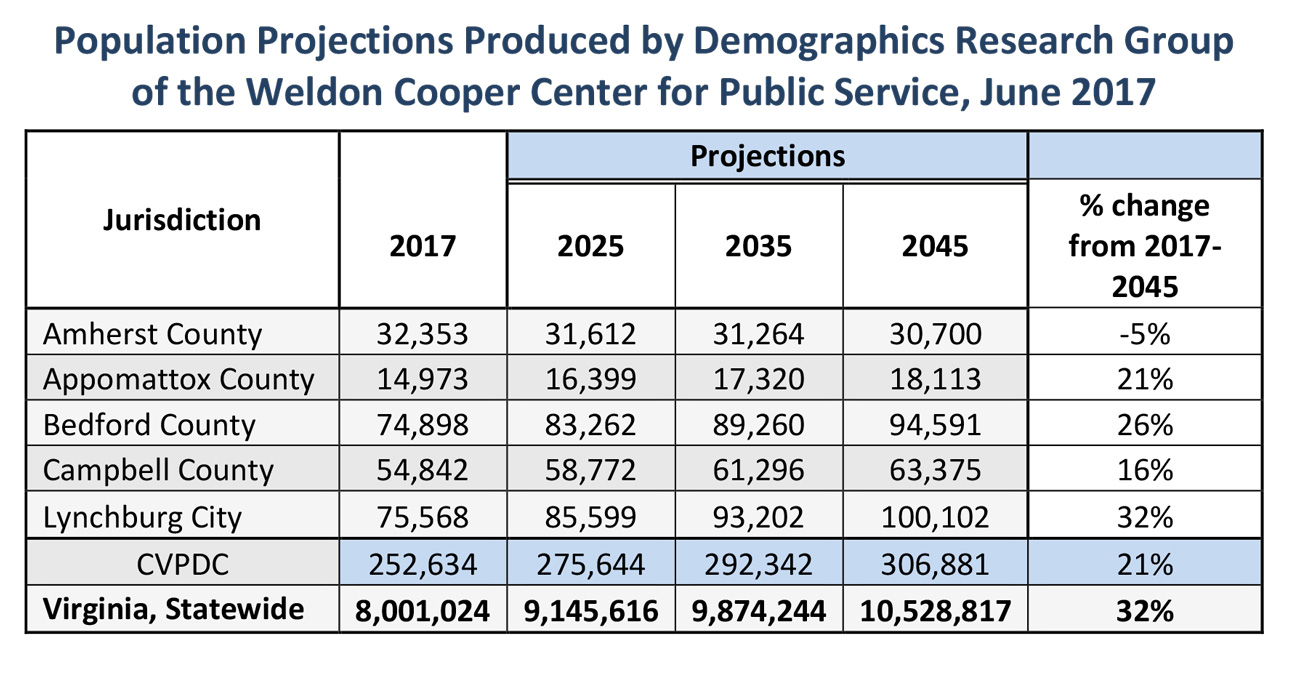
The US Census provides data on population, demographics, and housing via the “American Factfinder” website. A tutorial on how to use the website can be found HERE
- Details
- Parent Category: Content
- Category: Resources
CVPDC staff uses GIS to perform geospatial analysis by using data layers such as roads, municipal boundaries, population data, income data, infrastructure data, etc. GIS mapping is used in various regional plans and initiatives to help visualize the aforementioned data to the various audiences.
The localities in the CVPDC make parcel data available through their respective GIS viewing portals and includes addresses, owner names, sale dates, sale prices, assessments, and other property detail.
- Amherst GIS: https://experience.arcgis.com/experience/45d7ce9ea48c44cdb1e35afc94aa62e9
- Appomattox GIS: https://experience.arcgis.com/experience/dc7e850b09a64019a04398dadaba2729
- Bedford GIS: https://bedfordcova.interactivegis.com/login/
- Campbell GIS: https://parcelviewer.geodecisions.com/Campbell/Account/Logon
- Lynchburg GIS: https://mapviewer.lynchburgva.gov/ParcelViewer/Account/Logon
VDOT provides real time Traffic Information through the following website: http://www.511virginia.org/